Effects of Tocotrienol Supplementation on Hair Growth in Human Volunteers
补充三烯生育醇对头发生长的影响
研究结果与讨论
三十八位有异常掉发情况或秃头的志愿受试者参加了研究,口服三烯生育醇组有21名志愿者(19男2女),安慰剂组(对照组)有17个志愿者(全部为男性)。该研究的人口年龄介于 18至59岁。受试者年龄范围广泛,因为掉发是不受年龄之限制。年轻的成年人与老年人都会有受到掉发问题的影响。此外,掉发可能是由于营养缺乏和氧化压力所导致,从而影响广泛的年龄组。受试者掉发问题大约有2~5年的时间。
研究开始前,针对受试组成员的头发数以及头发重量加以评估。安慰剂组受试者的毛发的平均数目基线为289.0 ± 98.3,而补充三烯生育醇组为284.8 ± 111.3。至于20股头发平均重量,安慰剂组受试者的毛发的平均数目基线为0.1002克和 ±0.0639,而补充三烯生育醇组为0.0920 ± 0.0565克。比较两组的两个参数并没有显著差异(P> 0.05)。
三十五位受试者完成了整个研究,并评价补充三烯生育醇的效果。三名受试者中止研究,一位(女)是三烯生育醇组,和两位安慰剂组。每个月记录与访视过程中,补充三烯生育醇的顺从性是令人满意的。两组皆无严重药物反应或有关的记录。从而表明,持续8个月服用100毫克的生育三烯酚是可以忍受的。研究方案也被认为是令人满意的,没有偏差协定的记录。
表1显示了受试者在基线,第4和第8个月的头发数量变化,以及发量增加的百分比变化。显而易见的是,三烯生育醇补充组,从基线到第8个月的时间,头发数量有逐渐增加,最后平均增幅超过 34%。相比之下,安慰剂组受试者没有表现出任何明显的发量增加,约减少0.1%。杜克的事后检验表明(Tukey’s post-hoc test),补充三烯生育醇的受试者头发增加并无安慰剂效应。成对比较还表明,8个月的时间,补充三烯生育醇组和安慰剂组噢试者的头发数量有显著差异。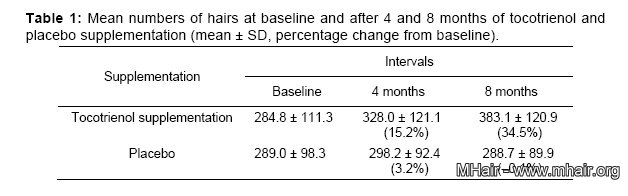
研究结束时,对于头发数量增加的效果评估,有一个志愿受试者例外。整体而言,8名志愿者(40.0%)显示头发增加了50%以上,1名志愿(5.0%)有25%至50%的增幅,9名受试者(45.0%)有增加10%至25%,而1名受试者(5.0% )为头发增加不到10%。只有1名受试者(5.0%)发量有些微减少。另一方面,在8个月后,在安慰剂组有8个志愿者显示有增加头发的数量,1名(6.7%),显示超过 20%的增长,其余 7名(46.7%),显示微不足道(negligible)的增加。7名受试者(46.7%)头发减少。
然而,两组的头发重量并没有显著增加。三烯生育醇补充组,平均百分比增重了5.9%的,而安慰剂组有轻微下降2.0%(见表 2)。研究结果之后,另行补充相关的研究显示,抗氧化剂可能被用来控制雄性秃掉发。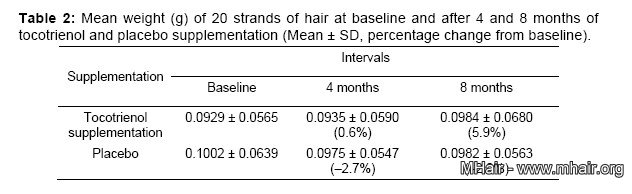
结论
总之,本试验表明,补充三烯生育醇胶囊的受试者与安慰剂组相比,头发数量有增加。一种可能的解释,效果可能是由于强大的抗氧化活性的生育三烯醇,以帮助降低头皮的脂质过氧化和氧化压力。
参考资料
Akar
A, Arca E, Erbil H, Akay C, Sayal A and Gur A R. (2002). Antioxidant
enzymes and lipid peroxidation in the scalp of patients with alopecia
areata. Journal of Dermatological Science 29(2): 85–90.
Bradfield R B and Bailey M A. (1969). Hair root response to protein malnutrition. In W Montagna and R L Dobson (eds.). Biology of skin, hair growth, vol 9; 7. Oxford: Pergamon Press, 109–119.
Cash
T F, Price V H and Savin R C. (1993). Psychological effects of
androgenetic alopecia on women: comparisons with balding men and with
female control subjects. Journal of the American Academy of Dermatology 29(4): 568–575.
Cash T F. (2001). The psychology of hair loss and its implications for patient care. Clinics in Dermatology 19(2): 161–166.
Van
der Donk J, Hunfeld J A M, Passchier J, Knegt-Junk K J and Nieboer C.
(1994). Quality of life and maladjustment associated with hair loss in
women with alopecia androgenetica. Social Science & Medicine 38(1): 159–163.
Girat
M, Cervello I, Nogues M R, Puerto A M, Ortin F, Argany N and Mallol J.
(1996). Glutathione, glutathione S-transferase and reactive oxygen
species of human scalp sebaceous glands in male pattern baldness. Journal of Investigative Dermatology 107(2): 154–158.
Hee
C E. (2008). The involvement of ROS on androgen inducible TGF beta 1
regulation derived from dermal papilla cells; a suggestive implication
of ROS on androgenetic alopecia. Journal of the American Academy of Dermatology 58(2) Suppl 2: AB84.
Hogan D J and Chamberlain M. (2000). Male pattern baldness. Southern Medical Journal 93(7): 657–662
Inui S, Fukuzato Y, Nakajima T, Yoshikawa K and Itami S. (2003). Identification of androgen-inducible TGF-β1 derived from dermal papilla cells as key mediator in androgebetic alopecia. Journal of Investigative Dermatology: symposium Proceedings 8(1): 69–71.
Koca
R, Armutcu F, Altinyazar H and Gurel A. (2005). Evaluation of lipid
peroxidation, oxidant/antioxidant status and serum nitric oxide levels
in alopecia areata. Medical Science Monitor 11(6): 296–299.
Kirk R E. (1968). Experimental design: Procedure for the behavioural
science. CA, USA: Brooks/Cole Publishing Company.
Naziroglu M and Kokcam I. (2000). Antioxidants and lipid peroxidation status in the bllod of patients with alopecia. Cell Biochemistry and Function 18(3): 169–173.
Papas A M. (1999). Vitamin E: Tocopherols and tocotrienols. In A M Papas (ed.). Antioxidant status, diet, nutrition and health. Boca Raton, Fl: CRC Press, 189–210.
Price
V H, Menefee E, Sanchez M, Ruane P and Kaufman K D. (2002). Changes in
hair weight and hair count in men with androgenetic alopecia after
treatment with finasteride, 1 mg daily. Journal of the American Academy of Dermatology 46(4): 517–523.
Rushton D H, Norris M J, Dover R and Busuttil N. (2002). Causes of hair loss and the developments in hair rejuvenation. International Journal of Cosmetic Science 24(1): 17–23.
Rushton
D H, Ramsay I D, James K C, Norris M J and Gilkes J J H. (1990).
Biochemical and trichological characterization of diffuse alopecia in
women. British Journal of Dermatology 123(2): 187–197.
Rushton D H. (2002). Nutritional factors and hair loss. Clinical and Experimental Dermatology 27(5): 396–404.
Serbinova
E, Kagan V, Han D and Packer L. (1991). Free radical recycling and
intramembrane mobility in the antioxidant properties of alpha tocopherol
and alpha tocotrienol. Free Radical Biology and Medicine 10(5): 263–275.
Sims R T. (1968). The measurement of hair growth as an index of protein synthesis in malnutrition. British Journal of Nutrition 22: 229–236.
Theriault A, Chao J T, Wang Q, Gapor A and Adeli K. (1999). Tocotrienol: A review of its therapeutic potential. Clinical Biochemistry 32(5): 309–319.
Traber
M G, Podda M, Weber C, Thiele J, Rallis M and Packer L. (1997).
Diet-derived and topically applied tocotrienols accumulative in skin and
protect the tissue against ultraviolet light-induced oxidative stress. Asia Pacific journal of Clinical Nutrition 6(1): 63–67.